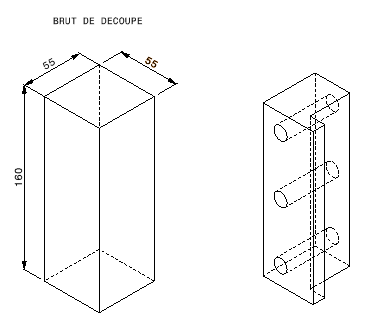
Hello, I have a question about the transmission of solidworks files, between two sectors of the same company. The technical office creates finished product files. The Methods/Indus service returns the BT file, and makes certain changes such as the implementation of over-thickness for example.
The goal is to keep the link with the BT part. The only solution I can consider is to create a new part and use the " Insert Part " function of the finished part, and then be able to work the volume with the different adjustments established.
However, with this method we have access to sketches and plans, without being able to modify them. You have to recreate new functions on the part to modify it.
And is it possible to carry out a hetiage of the part while keeping the construction shaft, which can be modified, without this impacting the initial part of the technical office?
Thank you in advance for your precious feedback, and have a good day to all
Indeed the derivative parts (insert part function) is a good way (the most relevant in my opinion) to keep the link between the 2.
CAUTION: Sketches imported via the Insert Part function are not completely locked, and it is possible to move them in certain situations. This is why I recommend the use of direct editing functions (offset face, delete face, etc.) which does not rely on sketches for operations such as adding extra thickness, placing at the middle dimension, converting fillet to chamfer or vice versa...
A copy of the document responds to this request; but I imagine that you want this copy to evolve with the modifications that can be made on the original... Updated build tree copying does not exist... And that's a good thing in my opinion.
I'm more of the " Copy + hint " school (or copy with new file name) but it's probably not easy to manage without PDM.
The configurations are surely a possible alternative but here too everything will depend on the " methodology " of the two offices (Vs Studies method).
If you want to get your feet in the way, the configurations are great: You have to be ultra rigorous on the methodology because otherwise you quickly end up with a modified dimension in the wrong configuration (and that's the drama...).
Managing feature deletions without changing dimensions is a bit less risky (and more visual in the creation tree too). It is not necessarily suitable for all types of rooms though.
Indeed, if you modify the dimensions according to the configurations it can be risky, but with the removal of functions and an adapted methodology (working with derived configurations, naming functions clearly, grouping functions by folders in the tree for more clarity etc...) it can be a good solution.
For my part, I use cfg to make my blanks before machining. This does not pose a problem of confusion in the assemblies if you take care to merge your stock with the finished part. Thus, all the constraints in the assembly that bind the part in question will be eliminated and visually " unmissable ". Views in the MEP