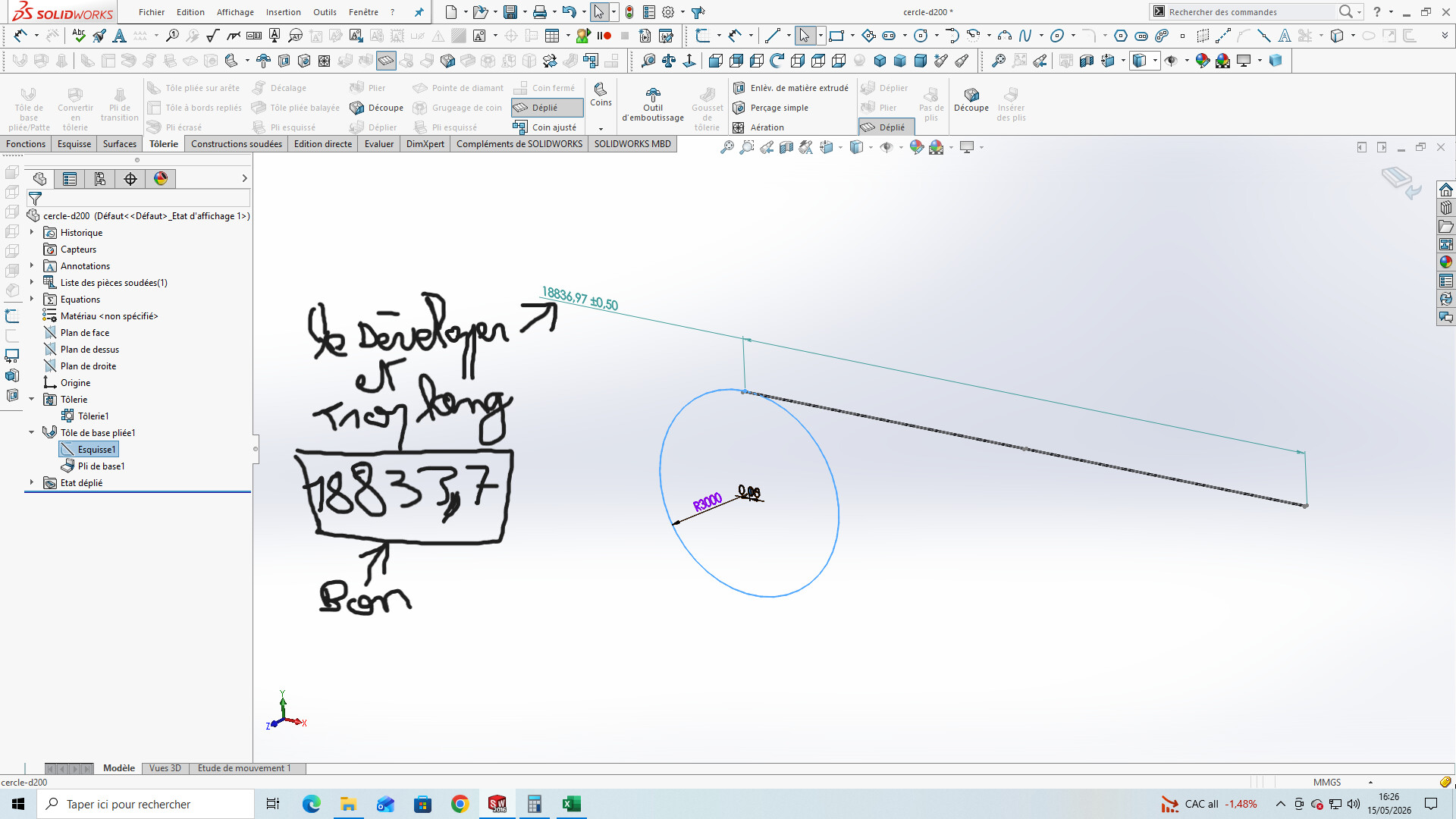
Bonjours à tous, je voudrais déplier un cylindre de tôle d" un rayon ext de 3000 ep 2
en utilisant le facteur K pour le dépliage, le problème cet qu’ayant régler le facteur k au mini, (0.01)je suis toujours trop long,(essai fait sur une rouleuse)quel qu’, un a t il une idée. merci pour vos réponses, je met une capture d’écran
Je dirais mieux vaut avoir à recouper!
Les opérations de roulage ne sont pas aussi précises en calcul théorique que pour les op de pliage. Surtout quand il s’agit d’une longueur développés de plus de 18m.
Si vous sous-traitez cette réalisation le S/T vous appliquera une surlongueur avant soudre des extrémités
Hello, en calculant à la fibre neutre on trouve 18843.3mm, pour une épaisseur de 2mm on trouve extrados : 18 849,6 mm et en intrados : 18 837,0 mm
dans SOLIDWORKS, le facteur K et les fonctions de perte au pli sont prévues pour des plis localisés (pliage presse plieuse), pas pour un roulage cylindrique continu.
Pour obtenir la valeur dans solidworks :
Si votre rayon extérieur doit être 3000 mm :
rayon intérieur à entrer : 2998 mm
épaisseur : 2 mm
facteur K : 0,5
Alors le rayon neutre devient : 2998+0.5x2=2999
et le développé théorique :
18843,29 mm
Les chaudronniers travailleront généralement en fibre neutre.
En même temps 3-4 mm de plus sur un tel développé, cela ne change pas grand chose sur le diamètre final!
Et assez peu de revendeur de tôle de 18m de long!
Le jeu sera probablement comblée ou déformée par la soudure.
Pour moi, ce que l’on m’a appris en chaudronnerie pour la fibre neutre, facteur K=0.5mm pour tôle inférieur à 3mm et Facteur K=0.33 pour ép supérieur à 4mm.
Pour des grand Ø le dev ne change pas tant que cela, la différence une fois roulée est très mineur. Sur un petit Ø cela reste plus pronocée
« La tôle est trop longue », question intéressante.
Petit questionnement sur les techniques utilisées pour ces tôles de grandes longueurs…
Première réflexion : enrouler une tôle de 2 mm d’épaisseur, initialement plane, sur un rayon de 3000 mm garde la matière dans le domaine élastique, ce qui signifie que la fibre neutre est au milieu de son épaisseur.
L’opération de roulage a pour intérêt de forcer la tôle, par déformation plastique, a se rapprocher de la forme cylindrique finale (rayon 3000 mm).
Avec un ratio rayon/épaisseur énorme.
Donc, si on se réfère aux usages de la tôlerie : K = 0.5.
Et la longueur théorique indiquée par @Scofield1 serait la bonne : 18843.3 mm.
Deuxième réflexion : la mesure.
Comment est mesurée la longueur de la tôle, sans doute déroulée depuis une bobine. Entre la longueur théorique et la longueur « convenable » de 18833.7 mm, il n’y a qu’environ 10 mm d’écart, soit 0.05% de la longueur totale, un demi-millimètre par mètre…
Est-on dans la zone de précision de l’appareillage de mesure ?
Toujours au niveau de la mesure : comment est validée la longueur « convenable » de 18833.7 mm. Je suppose qu’après roulage, le diamètre du cylindre obtenu a été mesuré.
Là aussi, avec quel moyen, quelle précision ?