Bonjour à tous,
N’ayant pas été actif depuis un moment je voulais poster un sujet qui me trotte dans la tête.
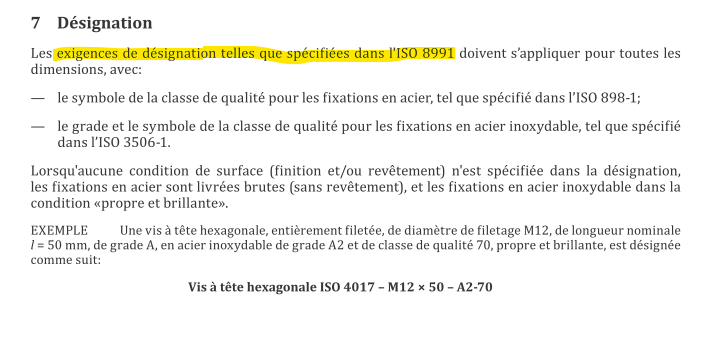
Je recueillir vos avis sur la désignation de votre visserie (personnalisée ou pas).
Afin de faire évoluer cela dans notre BE; il est toujours bon de voir ce qu’il se fait ailleurs et ne pas travailler avec des œillères .
Par exemple chez nous une vis hexagonale M8x50 en acier galva classe 8.8 se nomme ainsi:
Vis H - M8 x 50
Si c’est de l’inox nous rajoutons A4 ou A2 à la fin
Si c’est de l’acier zingué on rajoute ZN
En revanche nous n’ajoutons pas de numéro de pièce, peut être qu’avec vos retours cela changera.
Je pense que la façon de gérer la boulonnerie sous SW est intimement lié à la façon de gérer la boulonnerie dans ta société.
Chez nous toutes les pièces ont un code article donc on gère aussi des codes articles sur la boulonnerie.
Pour le remplissage de la nomenclature sous SW, en plus de notre code article dans ne colonne, on a plusieurs colonnes de libellés. Si tu veux être précis, le mieux est de suivre l’exemple de @FRED78 et de prendre la désignation de la norme. Si tu trouves que c’est trop lord (ce qui est vrai), tu peux l’alléger tant que les utilisateurs du plan (client, monteur…) le comprenne.
L’essentiel est d’avoir un libellé le plus complet possible (donc idéalement celui de la norme), sur les documents qui te permettent d’approvisionner ta boulonnerie (la GPAO généralement).
Il faut définir les colonnes de la nomenclature.
Nous avons mise en place deux nomenclatures, Fabrication et commerce.
Colonne nomenclature fabrication :
Rep / identification (N°de fichier)/ indice modèle / description / qte / masse / matière / protection
Colonne nomenclature commerce (visserie incluse) :
Rep / description / qte / masse / matière / norme / protection
Dans le cas d’une vis:
xx / Vis H - M12x50 / xx /xx kg / CL8 / ISO 4017 _ 898-1 / tZn _ Galva à chaud
Dans le cas d’un boulon :
xx / Vis H - M30x200 / xx /xx kg / CL10.9-10 / ISO 4017 _ 898-1 _NF EN 15048 / tZn / Galva à chaud
La désignation dois être répartie dans l’ensemble des cases pour définir une vis, elle ne doit pas être dans une seule cellule forcément. Mais l’ensemble des éléments doit être presents et correspondre à la norme. La norme n’est pas une imposition mais celle-ci est fabriquer et proposer par les fabricant et fournisseurs par la désignation proposée dans la norme.
Dans certain domaine pointu et pointilleux (nucléaire) la norme est un language obligatoire comme son application. La forme de la nomenclature aussi, elle peut être imposé par le client, ce qui nous aide oriente sur la forme de celle-ci pour des clients qui n’impose rien.
Ok, l’idée pour nous est de condenser un peu tout ça.
On aurait par exemple une désignation / matière avec sa finition intégrée.
Ce qui nous donne dans le cas d’une vis:
« Vis H - M12x50 / Acier 8.8 galvanisé à chaud » pour une vis galva
« Vis H - M12x50 / Acier 8.8 zingué » pour une vis zingué
« Vis H - M12x50 / A4-70 » pour une vis inox
idem pour les écrous et boulons
En revanche pour les rondelles il n’y a pas de notion d’acier 8.8 mais plutôt 200HV
On les nommes simplement:
Rondelle - Ø12 / Acier galvanisé à chaud_Zingué_A4
Petit aparté.
Comme je suis souvent amené à générer/créer des macro qui utilisent souvent comme variable le nom ou les désignations des composants 3D, je déconseillerai l’utilisation des caractères suivants:
Les espaces " "
Les Ø ou ø
les \ ou /
les * ; + ; #
et tous les caractères spéciaux qui ne facilitent pas les démarches de programmations.
 .
.