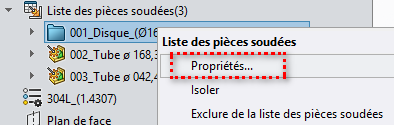
One of my customers integrates the index of his parts made with the Welded Construction module directly into the file name. He does not use PDM.
I encounter a difficulty when an element of a welded construction evolves, for example when a tube is modified .
In this case, I need to create a new subscript of the welded build file. However, the pipe file, which was created with the "Insert in a new part" function, remains linked to the old subscript of the welded build file.
So I end up with a tube that points to the old version of the welded construction, while I would like it to be able to follow the evolution of it.
What would be the simplest methodology to manage this type of case, especially when the elements of a welded construction are likely to evolve?
Hello; Obviously, the simplest thing would be to insert this new tube into an assembly, otherwise (in my opinion) only the management of descriptions or designations via the properties of the welded part list remains. But a good rigor is required.
But the link to your tube's new index will only be visible from the BOM. Another avenue to explore is the management of Configurations and parts families.
And as a last resort: No part evolution: modification = new part (new file).
Hello Fully agree with @Maclane the model indices when it's not managed by PDM or other, that's the... . Half the time, you forget to update them, and the other half the checkers don't see it The best is the enemy of the good, and normally the revision of the plan includes enough elements to judge the modifications that have been made (cloud, triangle of revision, line of revision). The only time you need it is when a customer has a quality follow-up worthy of the name (nuclear, military, etc...), and allows in case of maintenance to manufacture a part to the last index, but again the index of the plan is enough
So without PDM or other management to proscribe. I do it currently and I won't do it anymore or strongly advise against it. Which I had pointed out when starting a project with other cartoonists. But the Chefs do as they please and never take care of that, except to give their opinion.
The clue in the file name does not necessarily have to be deleted.
Indices related to the traceability of a part should not be confused with indices related to the traceability of a document linked to a part.
When you draw a part, it is represented by a plan = index, or 3D if it is the deliverable then model index. If you combine the two, there is an unnecessary redundancy, and heavy and at risk of forgetting it or making a mistake. Unless a management on PDM. Whether you modify the cosmetic of a plan or this same document through the modification of a part then the index rise is the same and applies to the document, the revision line or a follow-up document does the rest.
File name hints are very useful if you don't have an accurate list of documents and their revision statuses
The drawing will be indexed but not the name of the MEP file
Only the pdf will be indexed e.g.: -B-BPE + electronic signature and therefore will be the reference file that will be found later in the entire manufacturing process.
And I find that it works quite well, and not expensive to set up.
This is the right method. We have the name of the file in the title block which must also take up the index automatically, so we have to change the name of the CAD drawing file systematically. We never keep an earlier version of the drawing, unless we make a copy.
Thank you for this answer, it's also what I usually do, it's the cleanest and theoretically you can't go back on a 3D CAD file (however, nothing prevents you from archiving it but it's quickly cumbersome to manage).
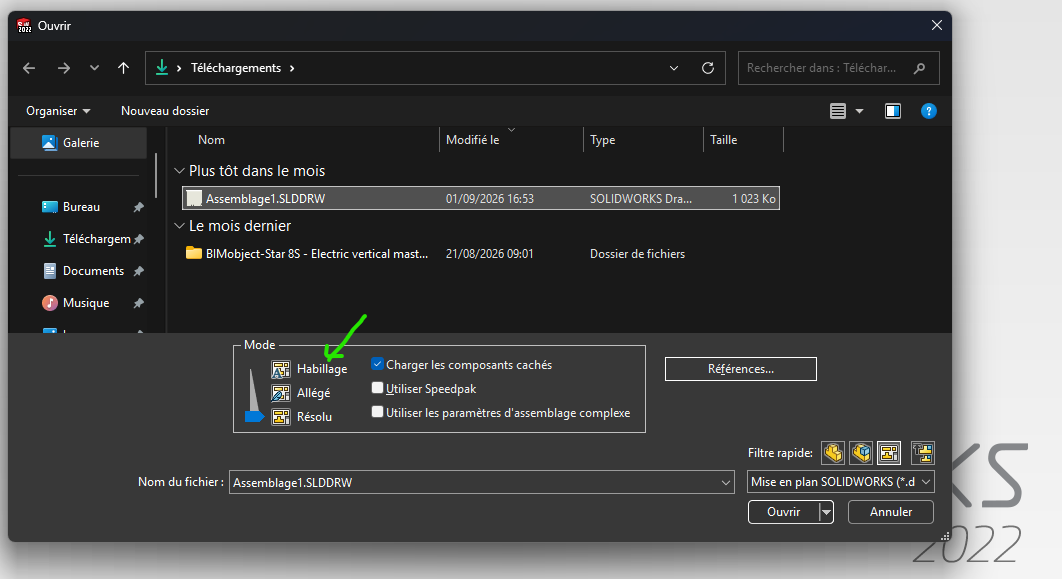
You can copy the old version of the SW drawing, and open it later as a skin, the model does not load, and you can open a drawing without it loading. It remains frozen.