My name is EL DIK Ahmad and I am a 3rd year student in Industrial Systems. As part of a project, I have to model a depowdering machine for parts printed in LPBF (metal 3D printing, mainly titanium). The school already has a printing machine, but there is a lack of an automated solution for the depowdering stage.
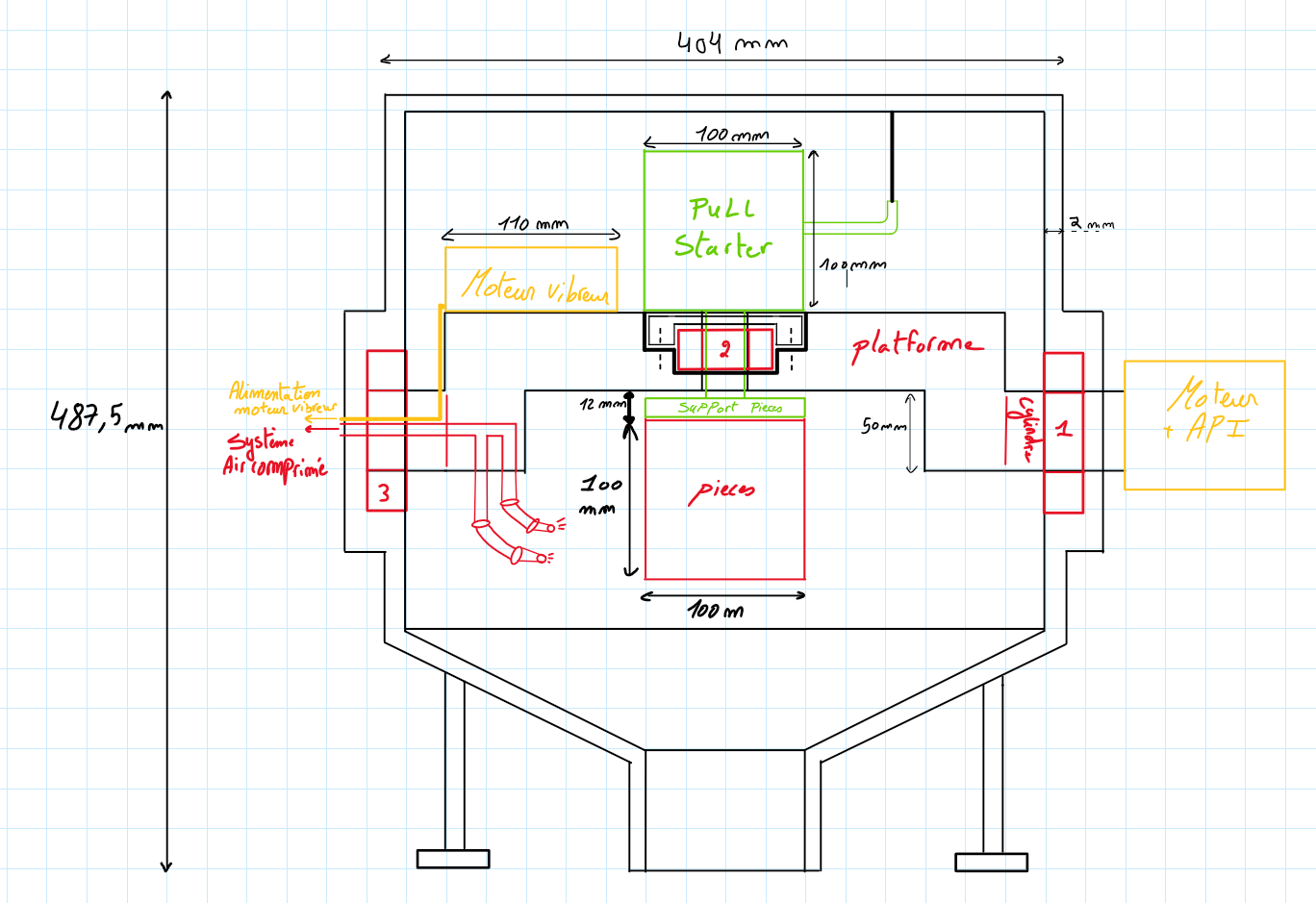
I have already made a diagram of my general idea: the objective is to make the printed parts vibrate, blow compressed air on them and use gravity to extract as much residual powder as possible.
In the attached figure, I show the principle of the system. The problem I have is this: I would like the vibrations to act only on the parts, and not on the whole machine. I had thought of attaching the vibrating motor to the rope launcher ("pull starter"), which is already used to rotate the printed parts, in order to avoid adding a second motor.
However, I am looking for a solution to isolate the "vibrating motor – pull starter – parts support – parts" system from the U-shaped rotation axis, so that this axis is not subject to vibrations.
Do you have any ideas or possible solutions (type of assembly, anti-vibration elements, mechanical design, etc.) to obtain this vibration isolation while maintaining the rotation of the parts?
Hello Why imagine such a complex machine to just depowder a part? Couldn't a vibrating bowl with powder recovery, for example, be suitable? The shape and coating of the bowl (tank) would have to be studied, but who says titanium part says rigid part, then it should not be a problem. All that remains is to design the loading/unloading ecosystem (small robot)
Thank you for your answer! but I don't see how a manual cleaning machine will help me with my vibration problem in an automated depowdering machine :c .
We have indeed studied the option of a vibrating bowl. Unfortunately, for the parts we print (max dimensions ~100 mm × 100 mm), a vibrating bowl alone is not enough. The residual powder is lodged in very deep and complex areas (internal channels, lattice structures, narrow cavities).
Under these conditions, the vibration is unable to extract all the powder:
the powder remains stuck by capillary action in the micro-cavities,
And even after compressed air + ultrasound + high-pressure washing, there is sometimes powder left.
This is why the school wants a more complete solution, combining vibrations + compressed air nozzles + controlled orientation of the rooms, in order to maximize gravity and access to the airflows. The aim is to be able to depowder several parts in a homogeneous and automated way, without manual intervention.
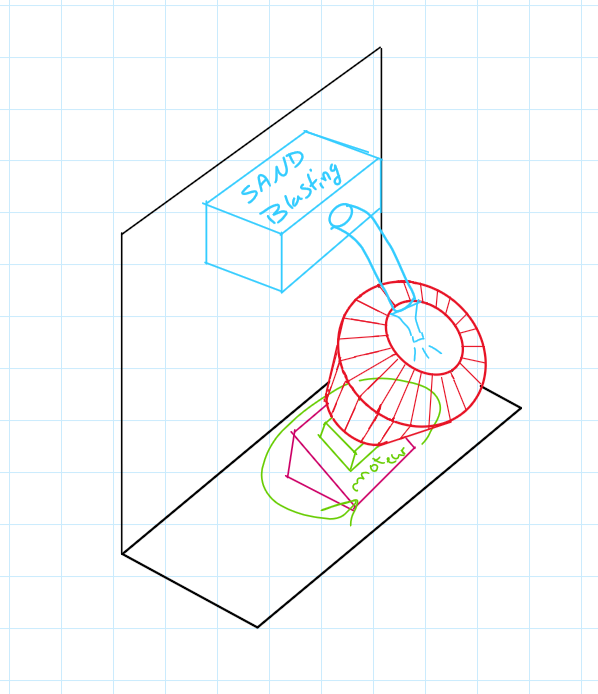
Moreover, the second stage of our project concerns automated sandblasting, already conceptualized with a rotating drum and a fixed nozzle for homogeneous treatment.
I'm surprised that in a school, you have such a large amount of parts to want to automate this process! For me, you have to take inspiration from vibrating conveyors and other processes of the same operation by vibration. Fixed frame and vibrating part taken up on fixed part by slat or spring. What do the manufacturers say about this kind of printer, They don't have ready-made solutions for depowdering? (Solution to get inspired or replace your idea depending on the cost.)
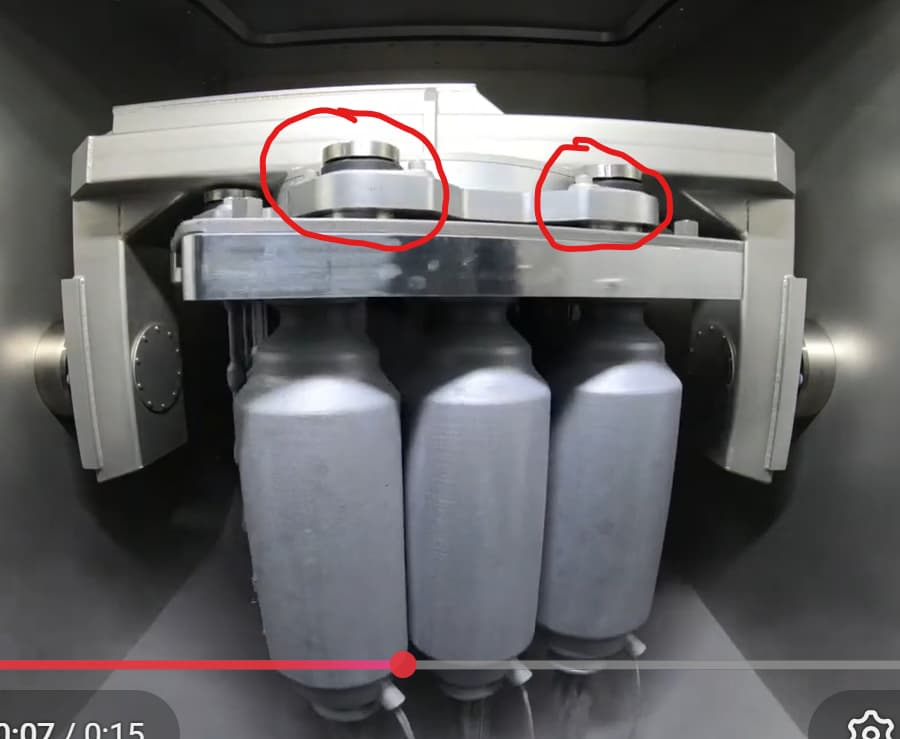
Hello Sbadenis, Thank you for your answer! in fact the school is a partner with a company that does 3D printing, the company itself has projects with many parts to print, I found a solution on youtube that is similar to mine, but for large parts: https://youtu.be/oQh0HK2v5xY?si=EwFbBeadeB4-hb_B
I see that they used some kind of vibration isolator, do you have any idea what is it called? (sorry for my French I am not a native French speaker)