Shop Floor Scheduling Solution

Hello everyone,

I work in a metalwork SME that brings together several activities (locksmithing, boilermaking and sheet metal work).

I am currently looking for a scheduling solution adapted to our workshop. Having found nothing really convincing at the moment, I would be curious to know your feedback and the tools you use on a daily basis.

Our main need is to be able to:

  • Plan a Production Order (PO);
  • Assign it to a specific operator;
  • Divide an OF into several phases or periods;
  • Manage priorities with dynamic re-planning (move an order and adjust the rest automatically).

For context, our manufacturing times vary greatly, ranging from one hour to several weeks.

Thank you in advance for your advice and recommendations!

Have a nice day!

1 Like

Hello,

What human resources do you have?
With us it's method technicians + workshop planner.
At the level of industrial ERP software + specific developments adapted to our activities + reporting and data extraction (we are ISO 9001/45001/CEFRI 1456E/EN1090 in preparation)

1 Like

Hello,

We have about ten workers, so it is possible to make an individual schedule and assign orders according to the skills of each one as well.

Hello

This kind of subject is very interesting, and also requires you to identify your specifications.
The answers may vary depending on the price. Between a small company of 10 people, 5 in production (versatile), 2 administrative etc... and another SME with 50 people, a production with several workstations, machines (therefore cost), etc...

In the first case, planning software, organization, and method, and some connected tool will do the trick, and will avoid a dependence on a rigid system.

On the other hand, ERP tools, from the beginning of the scheduling to the end of the finished product, management tools exist and are very well done. Supply management etc... all this with a different tool and interfaces from the administrator to the storekeeper. The rigidity of the system requires you to be very involved for the tool to work well.

And the blow can be surprising, from the audit to the training, and the cost of licenses and technical support in the event of a breakdown :smiling_face_with_tear:. But at the end of the day, when the system works, there are savings and we can rely on and anticipate needs. And let's not forget an IT department worthy of the name or at least the tools.

In short, you can't improvise the commissioning of a system like this without thinking about it carefully.

It is therefore necessary to identify:

  • The size of the company
  • The deployment mode
  • The Global Budget

Watch the software:

  • CLIPPER ERP
  • HERAKLES ERP targeted chaudro
  • Topsolid ERP for a design office
  • Silog ERP custom manufacturing
  • Divalto heavy boilermaking

After that, you have to find out, AI and Google would be a first step, and I invite you to do an audit and contact a supplier of this type of software to have a precise explanation of what can bring you

Here is my opinion

4 Likes

I will add certifications and customer requirements

1 Like

The certification and quality of the software provider and their seriousness

The wide range of job durations sounds like the tricky part here. A system might look good for one-hour operations but become awkward once an OF runs for several weeks and priorities change halfway through. I’d pay particular attention to whether the scheduler supports finite capacity by operator and automatic rescheduling of dependent phases. If those two pieces work well, the rest of your workflow should be much easier to manage.

2 Likes

Hello @Emma_Laurent

I totally agree with you.
This is the limit of standard ERPs that do not natively manage these two combined functionalities.

We fall into the limits of project management / production and logistics optimization.

Standard ERPs have serious weaknesses in real-time automation.

In a workshop:
What ERP does:
If the cutting phase is 32 days late, the ERP is quite capable of automatically postponing the start of machining and subsequent assembly.

The limit of the ERP

The ERP shifts the dates theoretically on paper (infinite capacity) without checking whether the operator or the machine will be available on that date

The classic ERP trap:
If three phases of dependent manufacturing are shifted at the same ^th time, the standard ERP will overload the operator.

Finite Capacity Management (What we are looking for in general):

The system blocks the schedule when an operator is at 100% of his daily load.
If phase 1 is delayed and shifts phase 2 to an already saturated day, the system automatically pushes the next day's phase, or triggers an alert to allocate a second operator

1 Like

Hello,

This is the role of the multi-activity planner (human) of each day: take a moment to measure tensions and reschedule activities according to the vagaries of manufacturing but also, for example, a customer emergency to be interspersed sometimes (to satisfy for a good commercial relationship), an absence...
Finally, many everyday situations to be solved in real time justify this job, it is not necessarily a full-time job.

1 Like

Hello @Le_Bidule

Yes for the planner, multi. But we are entering APS systems, dynamic GANT schedules that allow you to move tasks beyond the set dates and or to plan additional staff.
But this is done on the same software described above? Depending on the size of the company, we enter on heavy complex systems.

1 Like

Hello,
Thank you for your feedback.
To be honest, the solutions mentioned seem to me to be quite cumbersome to put in place.
For the moment we can get by with an Excel file but I'm looking for something a little more flexible without going into a very fine level of detail.
Most of our orders are processed by a single open from end to end. The Excel file works in principle but remains problematic when you have to move a command to put another one with a higher priority.

I was thinking of a drag and drop solution for OF that I could assign to an operator. With an estimated time for each OF.
I don't know if we can do this in tools like Monday, Trello, Notion, ...?

Thanks again
Greg

Hello @g_terraz

Apart from the excel file which works very well.
A workflow must be set up, and the scheduling of one or more tasks must be determined according to the products to be produced.

In a small company, we are in a flexible and simple system where communication works directly and is efficient, the number of positions is reduced.

In a large company (Airbus on the other hand), there are many players, as are the tasks. You have to set up a whole system.

In an intermediate company (50 people) we are faced with the same problem as a large company, but without the means.

You have to know the point of profitability of such a system.
What will it bring you? Today I work for a large construction group, I am in a department where we work as in a small company (the department that produces is limited to a few permanent contracts and the service that suffers :sweat_smile:, or not :joy:).
And the problems are managed by each of the positions, and when there are some, good will is enough :sweat_smile: , but it is dangerous and the problems are recurrent. Solutions exist to solve them but are costly and labor-intensive when you don't have the will or the means to put it in place

Exactly. The issue is less about shifting dates and more about whether the revised schedule is physically achievable. Finite capacity planning needs to consider actual machine and operator availability, otherwise the ERP only moves the problem further down the chain.

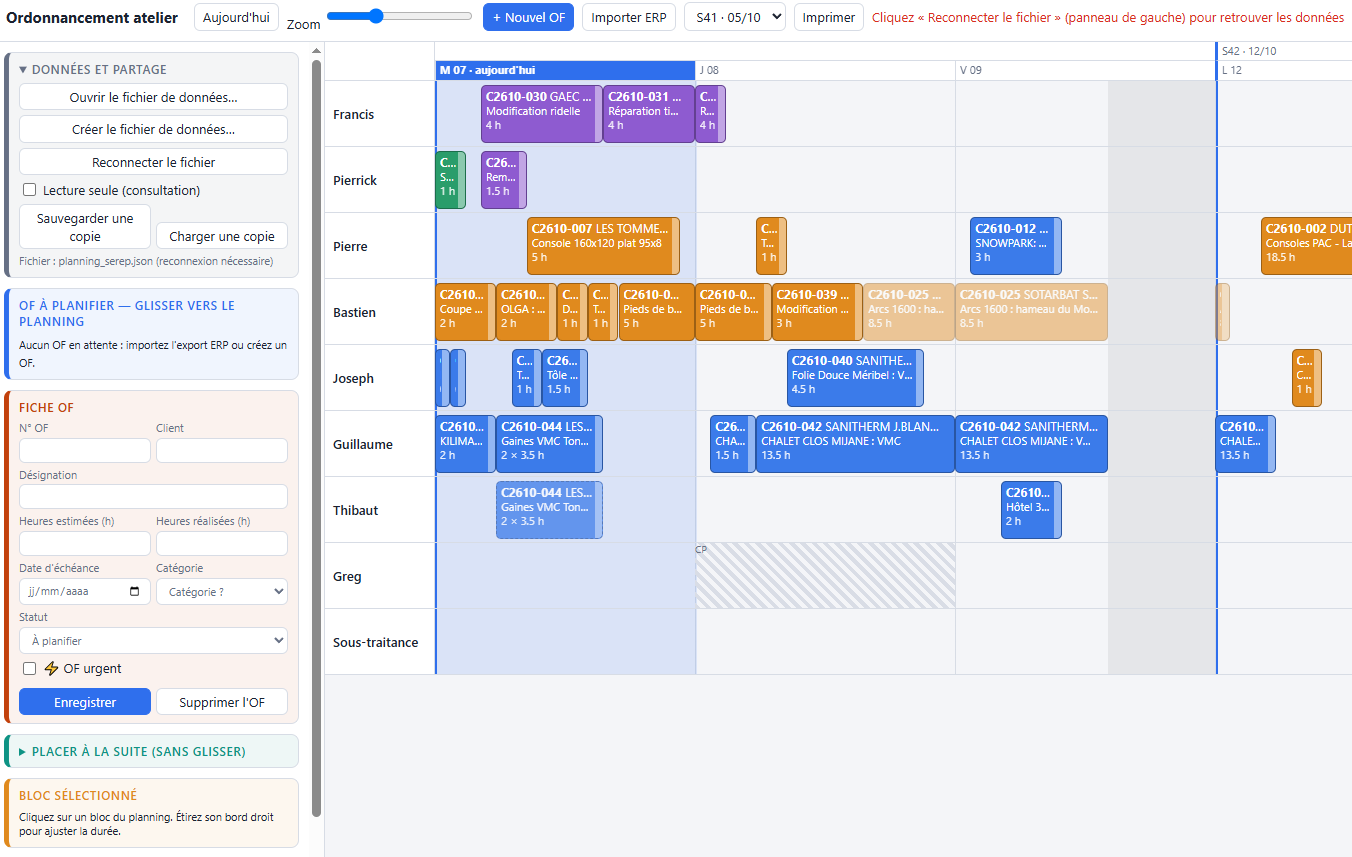
I ended up creating my own tool with Claude and it works great!

On what basis does this tool work? Can you tell us more about it?

PLANNING.rar (15.0 KB)

Attached if you want to try.
There are features specific to my need so I don't know if it will speak to you but it makes the coffee.

This is in the form of an html page and a .json file for the data.

Basically, I give him an export of my ERP with the current orders and it creates job sheets that I can drag and drop in the schedule.

I still have a few things to correct but I have exhausted my prompt quota for today :slight_smile:

image

3 Likes

I created the tool in 1 morning and it's better than the one we bought with our ERP... These AIs are still crazy!

3 Likes

We have to develop the subject here, I'm sure it would interest people
What do you use? Programming an existing tool?
Nice work

I used Claude.
No programming, I started with a simple prompt:
"
I work in a metalwork SME where several activities coexist (locksmithing, boilermaking, sheet metal work).
I want to create a scheduling tool for our workshop.
The goal is to create a tool that allows, among other things, to:

** Schedule a OF,*
** Assign it to an operator,*
** Be able to divide the OF into several periods,*
** Manage priorities, so move one job and forward the rest automatically.*

The work we carry out ranges from 1 hour to several days, or even several weeks.
Ask me the questions necessary to create this tool.
"

He asked me a series of questions:
"
Here are the questions that will allow me to frame the tool. No need to answer everything at once: start with blocks 1 to 3, they are the most structuring.

## 1. Support and use

** What do you want the tool on: Excel, a web page (HTML, usable in the browser) or something else? Is Excel imposed by the existing?*
** How many people use it, and at the same time ? Who modifies the schedule (only you, the workshop manager, several project managers) and who only consults it?*
** Where does it appear: desktop PC, monitor on the shop floor, tablet, phone?*
** How many OF are active at the same time, and over what horizon do you plan (2 weeks, 3 months)?*

## 2. The OF and its data

** What information does a job order contain: number, customer, business, designation, activity (locksmith / boilermaking / sheet metal work), estimated time, requested delivery date, status?*
** Do the OFs come from an ERP / CAPM software, or are they created by hand? Do I need to be able to import them (Excel, CSV)?*
** Is an OF composed of routing/operations (cutting → bending → welding → finishing), or is it a single block of time?*
** Are there dependencies between work orders (e.g. the sheet metal work must be finished before the locksmith assembles) or between operations of the same work order?*

## 3. Resources and operators

** How many operators, and what skills do they have (welder, bender, locksmith, multi-tasker)? Should a job be assigned only to qualified people?*
** Can an OF be carried out by several operators in parallel or always by a single one?*
** Do we also have to manage the machines/workstations (bending machine, plasma, laser, paint booth) as limited resources, or only the operators?*
** What are the working hours (hours per day, days worked, shifts)? Do you manage holidays, absences, public holidays, overtime?*

## 4. Division and Planning

** When you divide an OF into periods, is it manual (you choose the slots) or automatic (the tool fills in the availability)?*
** The granularity of the schedule: hour, half-day, day?*
** Can the periods of the same OF be made by different operators ?*
** Are there any downtimes to be expected (drying, waiting for material, subcontracting, control) during which the OF does not occupy anyone?*

## 5. Priorities and auto-shift

** When you move an OF, what should happen to the next ones: everything automatically slides behind, or only those of the same operator? Do the OF the same case follow together?*
** Can an OF be locked (closed date, critical customer) so as not to be postponed?*
** Should an urgent OF be able to interrupt another in progress, with resumption afterwards?*
**Do you want an alert when a delay causes the delivery date to be exceeded?*

## 6. Tracking and display

** Should we enter a progress (time actually spent, % completed), and compare the planned to the realized?*
** Which view would be most useful to you: Gantt per operator (lines = operators, drag and drop of POs), prioritized list, load per week?*
** Is a colour code by activity or status desirable?*
** Do I need exports or printing (weekly schedule by operator, for example)?*

## 7. Background

** Are you currently using a schedule (Excel, whiteboard, paper)? If so, what annoys you the most about it?*
** Do you have a concrete example of a schedule or (anonymized) OF to share? This would be the best starting point to build something realistic.*

If you have to prioritize a few, tell me especially the support (Excel or web), the number of operators and OFs, and how the automatic shift should behave. With that, I can already offer you a first prototype.
"

Then, he created a first model and I then iterated 5 or 6 times, giving my remarks and requests for improvement each time.

Now the tool is perfect, it's great!

3 Likes

Nice use of AI in our :mountain: :mountain_snow: :mountain:.

For your information, it's a subscription Claude to how much did you allow you to create this html + JSON page?
If it's the Free it's ultra profitable...