Hello everyone,
I check a cage ladder that equips a removable maintenance walkway. This ladder is in 2 parts because the lower part must be able to be removed when this footbridge is stored on the ground. The scale is therefore composed of:
- a fixed steel part welded on the gangway with a cage and an access gate
- a removable part which is a commercial aluminium ladder and whose first 2 upper rungs are housed in hooks provided on the fixed part
The objective is therefore to verify:
- The removable aluminium ladder due to its unconventional use (support via the rungs)
- The fixed ladder, especially the part with the support hooks
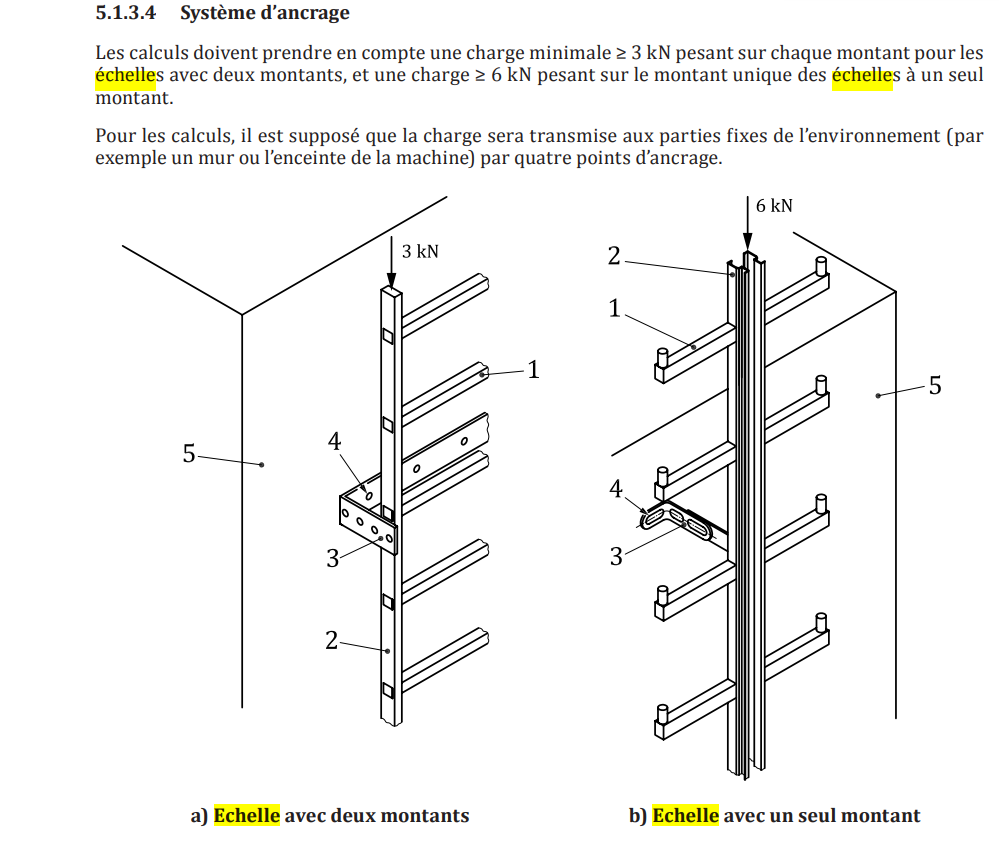
For load cases, I base myself on the ISO 14122-4 standard but I have a little trouble interpreting the simulated loads presented there; We have:
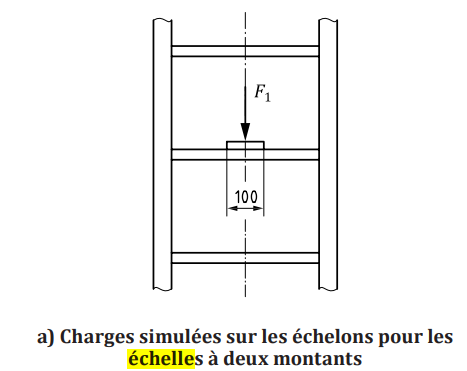
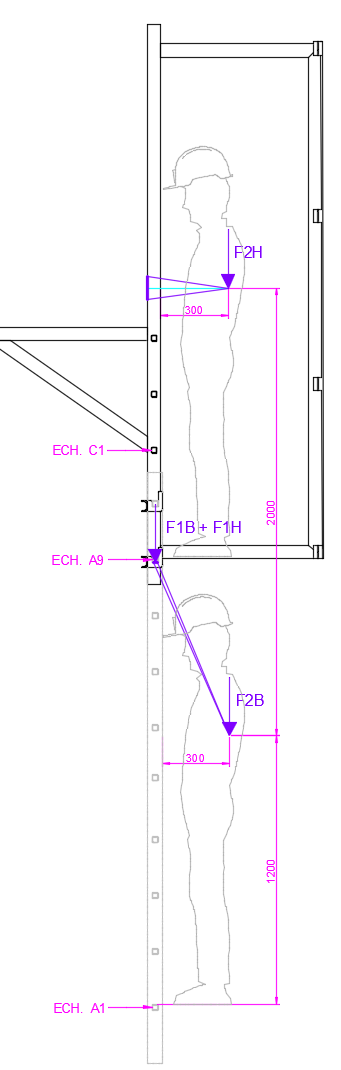
- An F1 load applied to a rung, over a width of 100mm, which logically corresponds to the load of a user via one of his feet resting on the rung, (standard value 1.5KN)
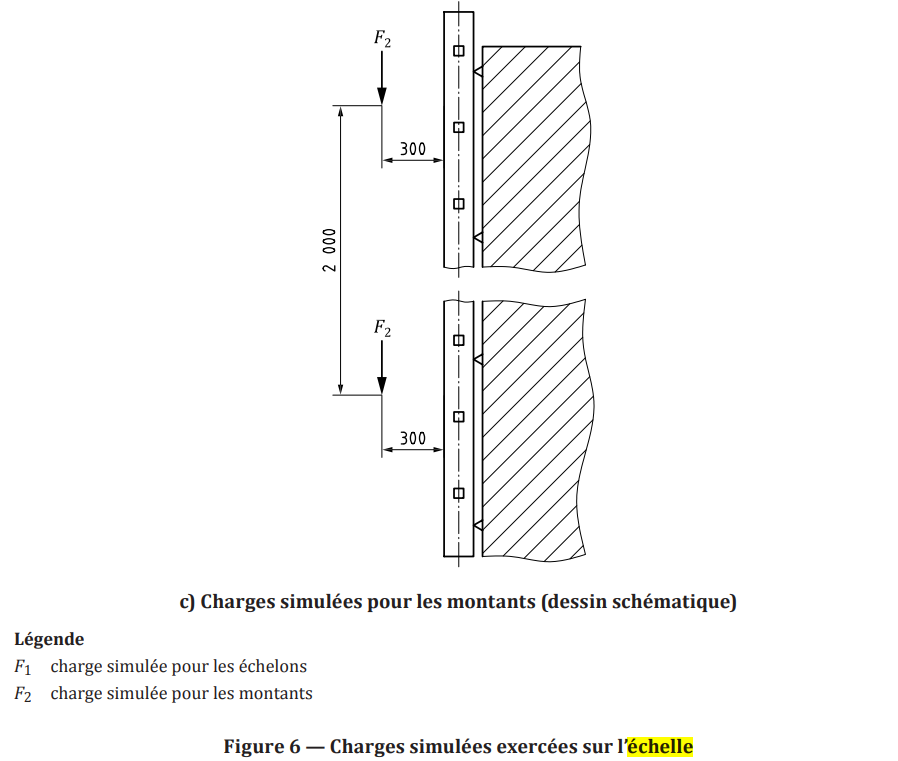
- An F2 load that seems to model the load of a user holding on to the uprights (standard value 1.5KN); it is a remote load but the area of application is not specified (for my part I considered an area of 100mm at the back of each upright and horizontal of F2 which corresponds to the hands of the user...)
I have a bit of trouble seeing if these solicitations should be applied simultaneously or each separately.
Simultaneously: we apply 2 times the user's load, which is very overloaded for the calculation
Separately: for F1 alone we can consider that the user climbs the ladder near the uprights by holding on to the rungs and neglect F2 but if we apply F2 alone it is equivalent to considering that the user holds on to the uprights but has no foot on a ladder rung...
I don't really know if I'm asking myself too many questions or if I'm completely wrong...
Does anyone have an idea?
In p.j.:
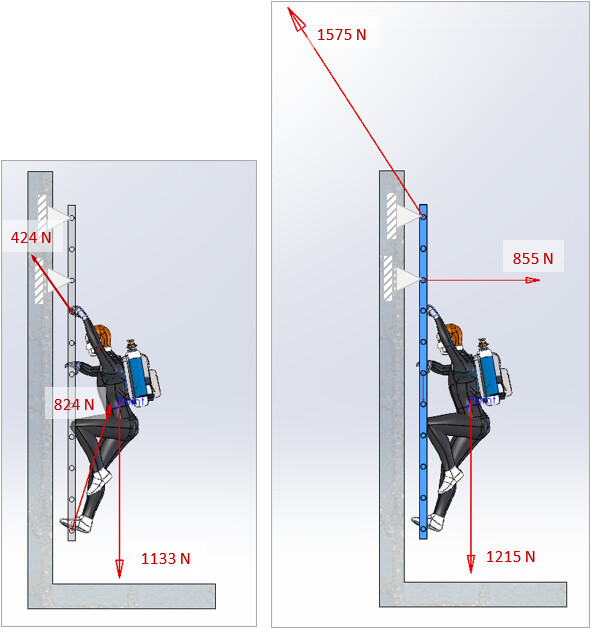
A diagram of the loads applied simultaneously (F1 + F2) on the fixed scale via the 2 lower brackets. Let's take the most unfavorable case with 2 users on the aluminum scale:
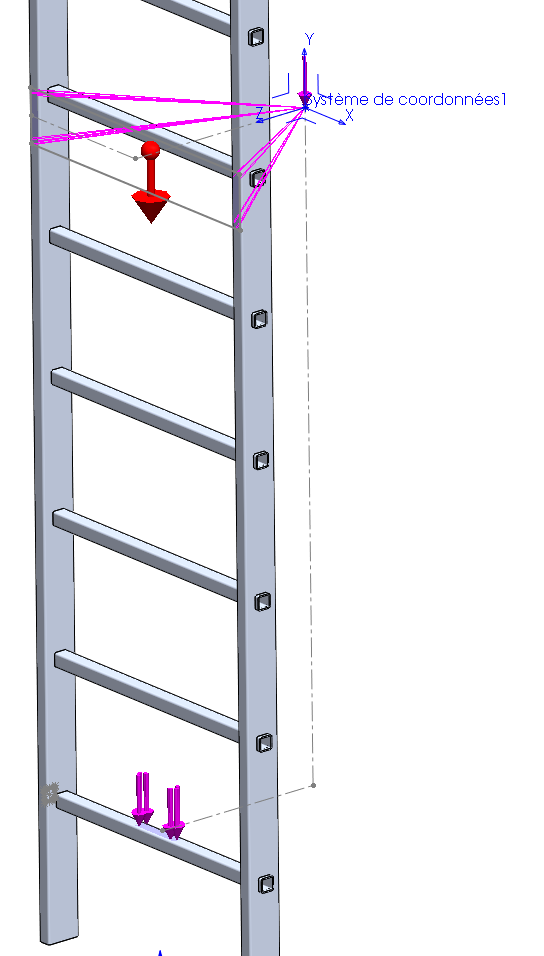
A view of the loads applied for the verification of the aluminum ladder this time:
Thank you in advance.